
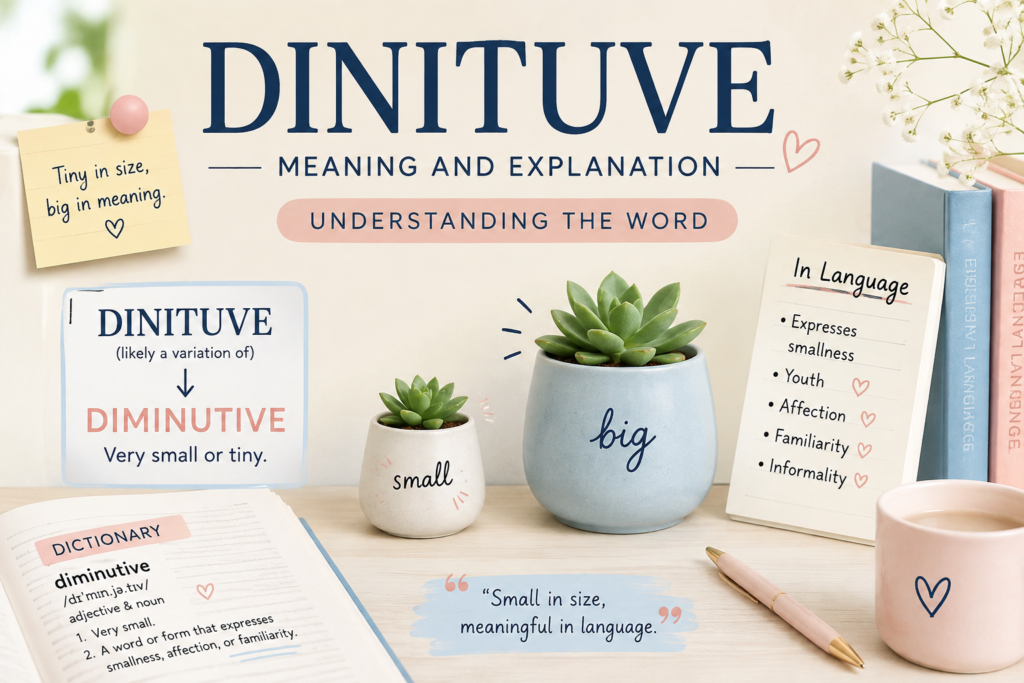

The word dinituve may appear in searches as a spelling variation or typo of diminutive, a common English word meaning very small or tiny. In language, diminutive has a more interesting meaning because it can describe a word, name, or suffix that expresses smallness, youth, affection, familiarity, or sometimes a sense of informality. If you came across “dinituve” while searching for a definition, the most useful thing to know is that diminutive is the standard English spelling. Understanding this small spelling difference can make the meaning much clearer.
What Does Dinituve Mean
Dinituve is generally understood as a misspelling or variation of “diminutive.” The standard word, diminutive, describes something that is unusually small or a linguistic form that indicates smallness, youth, affection, or familiarity. For example, someone might describe a tiny version of an object as diminutive, while a shortened or affectionate name such as “Lizzie” for “Elizabeth” may also be described as a diminutive form.
The Correct Spelling Is Diminutive
When searching dictionaries, grammar resources, or language references, you will normally find diminutive, not “dinituve.” The spelling contains the sequence d-i-m-i-n-u-t-i-v-e, which can be easy to mistype because the word is not pronounced exactly as every letter might suggest. This is why people sometimes search for alternative spellings such as dinituve when they remember the sound but not the exact written form.
Diminutive Meaning in Simple English
In simple English, diminutive means very small. It can describe a person, animal, object, or thing that is noticeably smaller than usual. For example, if someone sees a very small puppy, they might call it diminutive. The word can also be used in a figurative way when talking about language, names, or expressions that communicate smallness or affection.
Diminutive as a Linguistic Term
In linguistics, diminutive has a more specific meaning. A diminutive is a modified word or name that communicates the idea of something being small, young, familiar, or affectionate. Different languages create diminutive forms in different ways. Some add special endings to words, while others change the structure of a word. The purpose is often more emotional than simply describing physical size.
Why People Search for Dinituve
People may search for dinituve because they have encountered the word somewhere and are unsure about its spelling or meaning. Search behavior often reflects how words sound when spoken rather than how they are written. Since “diminutive” is a relatively uncommon everyday word, it is understandable that someone might remember its pronunciation but type a different version into a search engine. In most cases, checking the standard spelling will lead to the word they are looking for.
Diminutive Examples in Everyday English
Diminutive forms can appear in ordinary conversation, especially when people use affectionate nicknames. A person named Robert might be called “Bobby,” while Elizabeth might become “Lizzie” in a familiar setting. These forms do not necessarily mean the person is physically small. Instead, they can communicate closeness, affection, youth, or informality depending on the context.
Smallness Is Not the Only Meaning
One interesting feature of diminutive language is that it does not always focus on physical size. A diminutive expression can carry an emotional meaning. Parents may use affectionate forms when speaking to children, friends may use shortened names with one another, and writers may use diminutive language to create warmth or tenderness. Therefore, understanding the word only as “tiny” misses an important part of its linguistic meaning.
Diminutive Names and Nicknames
Nicknames are one of the easiest ways to understand diminutive forms. A longer personal name can sometimes be changed into a shorter or more affectionate version. For instance, “William” can become “Willie,” while “Margaret” has historically had forms such as “Maggie.” Whether a particular nickname is technically a diminutive can depend on the language and naming tradition, but the general idea is that the modified form creates a more familiar or affectionate relationship.
Diminutive Suffixes
Many languages use special suffixes to create diminutive forms. A suffix is a group of letters added to the end of a word to change its meaning or grammatical function. English has some diminutive patterns, although they are less systematic than in languages such as Spanish, Italian, or Russian. Forms ending in -let, for example, can suggest something smaller, as in “booklet” or “leaflet.”
How Diminutive Works in Other Languages
Diminutive forms become especially interesting when languages are compared. In Spanish, suffixes such as -ito and -ita can express smallness or affection, depending on context. Italian also has several diminutive patterns, while Slavic languages often have rich systems of affectionate and diminutive forms. These differences show that the idea of making something “smaller” through language can also express relationships, emotions, and cultural habits.
Diminutive Can Express Affection
A diminutive expression can make speech feel warmer and more personal. Someone might use an affectionate nickname because it feels friendly rather than formal. This is especially common between family members, close friends, and romantic partners. However, context matters because a diminutive can sometimes sound patronizing if it is used toward someone who does not appreciate being addressed that way.
Diminutive Can Suggest Youth
Diminutive forms are also commonly associated with children or young people. Parents may use smaller or affectionate versions of names when talking to young children. Similarly, a word can be modified to create the impression of something young, delicate, or small. The emotional effect depends heavily on the surrounding conversation and the relationship between the speakers.
Diminutive Does Not Always Mean Cute
It is tempting to assume that anything diminutive must be cute, but that is not always true. The word primarily communicates smallness or a related linguistic idea. A diminutive form may sound affectionate in one situation but dismissive in another. For example, reducing someone’s name without permission could make them feel that they are not being taken seriously. Good communication therefore depends on understanding both the word and the social context.
Diminutive in Literature and Storytelling
Writers often use diminutive language to create a particular emotional atmosphere. A small object can make a scene feel delicate or vulnerable, while an affectionate nickname can reveal the relationship between two characters. In children’s literature, diminutive forms can make characters and objects feel friendly or approachable. Skilled writers use these details naturally rather than explaining the emotion directly.
Diminutive in Descriptive Writing
The adjective diminutive can make ordinary description more precise. Instead of repeatedly saying “very small,” a writer might describe something as diminutive when the context suits a more polished style. For example, “a diminutive cottage stood beside the enormous house” creates an immediate contrast between the two buildings. The word is especially useful when size is an important part of the image being created.
Diminutive Compared With Tiny
“Tiny” and “diminutive” are close in meaning, but they do not always sound the same. Tiny is an everyday word that feels simple and direct, while diminutive is somewhat more formal and descriptive. Saying “a tiny room” is completely natural in casual conversation, whereas “a diminutive room” sounds more literary or deliberate. The best choice depends on the tone of the writing.
Diminutive Compared With Small
The word “small” is broader and more neutral than “diminutive.” Something can be small without being unusually tiny. Diminutive often draws attention to noticeably reduced size or to a linguistic form associated with smallness, affection, or familiarity. This extra layer of meaning is what makes the word more interesting than an ordinary synonym for small.
Common Mistake With Dinituve
The biggest issue with dinituve is spelling. If you are writing an article, school assignment, professional document, or formal message, diminutive is the spelling you should normally use. Searching for “dinituve meaning” can still be useful because it may help someone who has encountered the misspelling find the correct word. Once the connection is understood, using the standard spelling makes your writing clearer and more credible.
How to Remember Diminutive Spelling
A simple way to remember the spelling is to break the word into smaller parts: di-min-u-tive. Writing it several times and using it in sentences can also help. Another useful trick is to connect the spelling with the meaning: diminutive refers to something diminished in size, which can make the beginning of the word easier to remember. With regular exposure, the spelling becomes much more familiar.
Is Dinituve a Real English Word
Dinituve is not the standard English spelling of the word usually intended by this search term. If you mean the adjective describing something very small or a linguistic form expressing smallness or affection, the correct word is diminutive. In informal online searches, spelling variations are common, so encountering “dinituve” does not necessarily indicate a different concept.
Why Understanding the Correct Word Matters
Knowing the correct spelling is useful because it helps you find reliable definitions, examples, and linguistic information. If you search for “dinituve,” you may receive limited or inconsistent results, while “diminutive” connects directly with the established English term. Correct spelling also matters when writing for school, work, websites, or search engines because clear language makes information easier for readers to understand.
How to Use Diminutive in a Sentence
The word can be used naturally in several contexts. You could say, “The diminutive house looked charming beside the larger buildings,” to describe physical size. You could also say, “The nickname is a diminutive form of her full name,” when discussing language. These examples show the two major uses: describing something small and describing a linguistic form associated with smallness or familiarity.
The Emotional Side of Diminutive Language
Language is rarely just about dictionary definitions. A diminutive form can carry feelings that are not obvious from the word itself. A nickname may communicate trust, affection, childhood memories, or closeness between people. That is why diminutives are important in sociolinguistics and everyday communication. They show how people use language not only to share information but also to express relationships.
Diminutive and Search Intent
Someone searching for dinituve may have several different intentions. They might want a spelling correction, a dictionary definition, a synonym, an example sentence, or an explanation of the linguistic term. The most helpful answer should address these possibilities without assuming too much. In most cases, explaining the connection between dinituve and diminutive provides the clearest path because it answers the likely question while teaching the correct usage.
Conclusion
The search term dinituve most likely points to the word diminutive, which means very small or tiny and has a special meaning in linguistics. A diminutive can be a modified word, name, or expression that communicates smallness, youth, affection, or familiarity. Although “dinituve” is not the standard spelling, understanding why people search for it can make the correct word easier to remember. When you need the formal English term, use diminutive.
FAQs
What does dinituve mean?
Dinituve is generally a misspelling or variation of diminutive, which means very small or tiny and can also describe a linguistic form expressing smallness, youth, affection, or familiarity.
What is a diminutive word?
A diminutive word is a modified form that can express smallness, youth, affection, familiarity, or informality depending on the language and context.
What is an example of a diminutive?
A common example is a shortened or affectionate name such as “Lizzie” used for “Elizabeth.” In other languages, special suffixes are frequently used to create diminutive forms.
Does diminutive mean tiny?
Yes. In its ordinary adjective use, diminutive means unusually small or tiny. In linguistics, it can have the additional meaning of expressing smallness or affection.
Is diminutive always affectionate?
No. A diminutive can express affection or familiarity, but its effect depends on context. In some situations, it may sound informal, childish, or even patronizing.
Read also: 7638526294 Safe Understanding Calls and Voicemails