


The quintessential image of UK university life—cobbled campuses, late-night library sessions, and the occasional pub quiz—is undergoing a drastic transformation. As we move through 2026, the British higher education landscape is defined less by “finding oneself” and more by an intensified race against time, inflation, and rigorous academic benchmarks.
According to recent Higher Education Statistics Agency (HESA) data for the 2024/25 academic cycle, over 2.86 million students are currently enrolled in UK HE providers. While participation remains high, the “student experience” has shifted from a purely intellectual pursuit into a high-stakes balancing act. This article explores the systemic pressures facing today’s scholars and the innovative strategies they use to stay afloat.
The Anatomy of the Modern Workload
The “standard” full-time degree in the UK is increasingly anything but. While traditional guidelines suggest a 35 to 40-hour work week, the actual cognitive load has spiked. Students today are not just writing essays; they are navigating complex digital learning environments, engaging in mandatory “employability” modules, and often managing the fallout of a post-pandemic assessment shift toward continuous coursework over final exams.
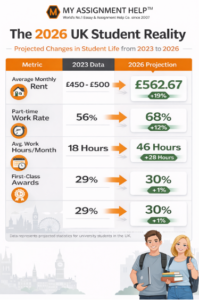
Recent findings from the Advance HE/HEPI Student Academic Experience Survey 2025 highlight a significant shift: students are now spending more time in paid employment than ever before. With 68% of all students working part-time—a 12% jump from the previous year—the “academic” portion of their week is being squeezed into increasingly narrow windows. For many, finding reliable assignment writing help UK has become a vital lifeline, allowing them to maintain high academic standards while fulfilling the economic necessity of 15–20 hours of weekly employment.
The “Cost-of-Learning” Crisis
We cannot discuss workload without discussing the Cost of Living. As of early 2026, students in the UK face an average monthly rent of £562.67, with London figures soaring much higher. The NatWest Student Living Index 2025 revealed that students now spend an average of 46 hours per month in paid work just to cover basic essentials—more than double the hours recorded in 2023.
This financial strain creates a “double burden.” When a student spends their daylight hours at a job, their academic tasks are relegated to the early hours of the morning. This exhaustion leads to a higher demand for academic support. When the pressure to perform becomes overwhelming, some students choose to delegate specific modules to experts, often searching for professionals to do my coursework UK to ensure they don’t lose their scholarship or fail a crucial unit due to simple burnout.
Data-Driven Insights: Mental Health and Performance
The correlation between workload and mental health is no longer a matter of debate; it is a statistical reality.
- Mental Health Prevalence: A 2025 scoping review noted that 37% of UK students reported moderate to severe symptoms of depression or anxiety—significantly higher than their non-student peers.
- Grade Inflation vs. Pressure: While 30% of first-class honours were awarded in 2025 (up 1%), students report that the effort required to reach that “First” has intensified due to more granular marking rubrics and increased competition for graduate schemes.
- Study Hours: Despite the rise in external work, independent study time has actually dipped slightly to 11.6 hours per week on average, as students prioritise high-impact tasks over general reading.
“The challenge isn’t just the volume of work; it’s the fragmentation of time. Students are switching between being a ‘learner’ and a ‘worker’ several times a day, which prevents the deep focus required for high-level academic research.” — Dr. Sarah J., Higher Education Consultant.
How Students are Navigating the Pressure
Faced with these challenges, the 2026 student cohort is becoming remarkably pragmatic. They are adopting “Academic Tech Stacks” to survive:
- AI Integration: Using AI for brainstorming and structuring (though navigating the strict UK university plagiarism policies remains a tightrope walk).
- Peer-to-Peer Support: The rise of digital study groups on platforms like Discord.
- Professional Academic Services: Utilizing specialized writing services for proofreading, formatting, and model answers to understand complex marking criteria.
- Micro-Learning: Breaking down 3,000-word dissertations into daily 200-word “sprints.”
The 2026 UK Student Reality
Conclusion
The growing pressure on UK Higher Education is a reflection of a society in flux. As universities navigate financial deficits and students navigate a volatile economy, the definition of “academic success” is evolving. Success in 2026 is no longer just about intelligence; it’s about resourcefulness. Whether through better time management, institutional support, or professional academic assistance, students are finding ways to persevere through the heaviest workloads in a generation.
Frequently Asked Questions (FAQs)
Q: How many hours should a UK student study per week?
Most UK universities recommend a total of 40 hours per week for a full-time degree, including lectures, seminars, and independent study.
Q: Is it legal to use assignment help services in the UK?
Yes, it is legal to use these services for model answers, research, and proofreading. However, students must ensure they follow their university’s academic integrity policies regarding “contract cheating.”
Q: Why has the student workload increased recently?
The shift is largely due to more “continuous assessment” (coursework) replacing traditional exams, alongside the need for students to work more hours in paid jobs to cover rising living costs.
References
- HESA (2026): Higher Education Student Statistics: UK, 2024/25. hesa.ac.uk
- NatWest (2025): Student Living Index 2025. natwest.com
- Advance HE/HEPI (2025): Student Academic Experience Survey. hepi.ac.uk
- Office for Students (2025): Financial Sustainability of HE Providers. officeforstudents.org.uk
Author Bio:
Ricardo Hunt is a Senior Academic Consultant at MyAssignmentHelp and Content Strategist specializing in the UK education sector. With over a decade of experience in higher education policy and student welfare, Ricardo focuses on the intersection of mental health and academic performance.